Die Eierschecke
From Dresden to California's Central Coast

When I left Germany on Mother’s Day of 1989, there was still an East and a West Germany—the DDR and the BRD. The East seemed murky, an impenetrable world, and food was certainly not something we envied our eastern relatives for. In fact, until a member of our Instagram community asked for it, I had never even heard of an Eierschecke cake — even though in 1988, a year before the fall of the wall, I had visited Dresden, the city where this delicacy originates. Somehow this particular cake never made it onto my radar, and I am not alone. But my very favorite German children’s book author, the wonderful Erich Kästner, was quoted saying: “The Eierschecke is a type of cake that, to the detriment of humanity, has remained unknown to the rest of the world.”
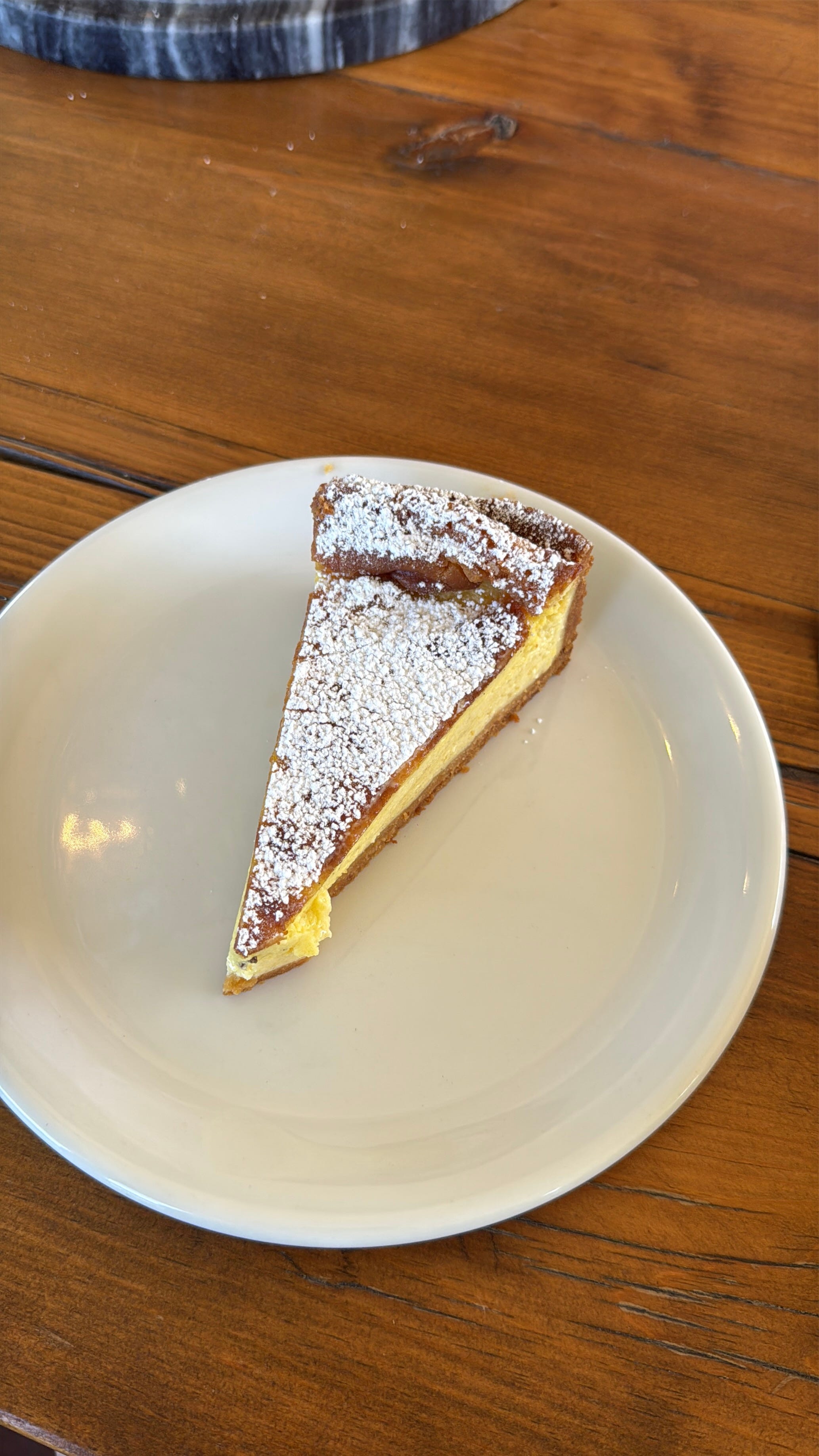
Since I am more of a “riffer” on traditional recipes than a slavish follower of recipe steps, here is my spin on this famous East Germany delicacy. In its essence the Eierschecke is a type of German cheesecake that adds a layer of pastry cream on top of the Quark filling. I know it is traditional to use ready-made pudding powder for the pastry cream. But I just like a rich pastry cream so much better, and Dr. Oetker’s vanilla pudding is not widely available here anyway. Crucial is the quark ( Stay tuned as I have a recipe coming next week that will explain how to make some fabulous quark at home) I hope I will be forgiven by the kitchen goods that I have not stuck to the original DDR recipe. My recipe is for a 9 inch springform.
For the crust I use my 3-2-1 but with toasted sugar. That gives some more caramel flavor; the crust bakes darker and more crumbly. Toasted sugar tastes a little like caramel but without the sugar actually melting. And you can replace it in any recipe for normal sugar. My goal was to pick up the flavor of the caramel on the fruit side also on the crust. To toast the sugar, you use a whole package of sugar to make it worth your while (2.2 lbs bag), since it will take you about 4-5 hours to toast. Pour it into a glass or ceramic form with a slow heat conduction, and put into a preheated oven at 300 degrees Fahrenheit. Start stirring the sugar after one hour, every half hour, until it is a very light brown. It might get a little clumpy but a food processor will help to pulverize it once it has cooled down.
The Crust
180 g all-purpose flour
120 g butter
60 g toasted sugar
a pinch of salt
1 teaspoon baking powder
Throw everything in the food processor. Once it is all mixed, bring it together with your hands. Form a disk, wrap it in plastic wrap, and put it in the fridge for at least an hour.
The Pastry Cream
I love a pastry cream with more yolks and more butter than traditionally used. It feels more luxurious, smooth, and rich on the tongue than your typical recipe.
250 g whole milk
1 vanilla bean, split and scraped
65 g sugar
5 egg yolks
25 g cornstarch
50 g unsalted butter, softened and cut into cubes
Whisk the egg yolks, half the sugar, and the cornstarch until creamy, about 3–5 minutes. Bring the milk, the scraped vanilla bean (or vanilla extract), and the remaining sugar (25 g) to a boil. If using the vanilla bean, let the hot milk sit and the vanilla steep for 10 minutes. Remove the vanilla bean and heat the milk again. Start pouring a thin stream of the hot milk into the egg, sugar, and starch mixture, whisking constantly. Once you have incorporated about half the milk, pour the egg-milk mixture back into the pot with the remaining milk. Place over medium heat and stir until the cream begins to bubble; hold it at that temperature, whisking constantly, for about a minute. Remove from heat. Once it has cooled to just above room temperature, whisk in the softened butter.
The Quark Filling
500 g quark
150 g heavy cream, whipped
150 g sugar
50 g butter, softened
2 egg yolks
75 g all-purpose flour
10 g cornstarch
zest of 1 lemon and juice of ½ lemon
Mix the soft butter and egg yolks with a mixer for 2–3 minutes on medium speed. Add the sugar, the lemon zest, and the lemon juice. Sift in the dry ingredients — flour, starch, and baking powder — and mix carefully until well incorporated. Beat the heavy cream until stiff. Fold the quark into the egg, sugar, butter, and flour mixture first, then carefully fold in the whipped cream. The goal is to keep everything as airy and light as possible. Pour the entire cheesecake filling onto the prepared shortcrust base.
Assembly and Baking
Roll out the dough on a lightly floured work surface and line the springform pan with the dough, pull the edge up about 2/3 of the height of the pan. Pour the quark filling in to the Springform. Spread the pastry cream on top and bake for 55–60 minutes at 325°F. Should the top get too dark, place a sheet of parchment paper on top of the cake. The cake is done when the center still has a jiggle — you do not want to bake it stiff. Turn off the oven but do not remove the cake. Stick a wooden spoon in the oven door to let the heat slowly escape. Let the cake cool slowly in the oven for 2–3 hours in the oven. Then let it cool down further until completely cooled. Dust with powdered sugar. Or not. :)
Is there a version that isn't metric, bitte? For the slow kids in the back of the classroom. . . danke.
Could you please kindly specify what toasted sugar means? I’ve never encountered this. Is there a way to toast sugar without melting it? Or is there an actual product called toasted sugar? Please and thank you!